
♻️

Composite Fencing Installation Specialists Across the UK

Low-maintenance fencing built from composite boards and slotted posts, sold as a system, that needs no staining or painting and will not rot, split or fade as timber does.

💰 Typical cost: £1,200–£4,000⏱ Timeframe: 2–4 days📋 Free surveys available
Job profileCost 5 of 5, Complexity 4 of 5, Duration 4 of 5, Dustiness 2 of 5, Disturbance 3 of 5Cost: 5 of 5Complexity: 4 of 5Duration: 4 of 5Dustiness: 2 of 5Disturbance: 3 of 5Cost5/5Complexity4/5Duration4/5Dustiness2/5Disturbance3/5
What the job involves, at a glance

What is composite fencing installation?

Composite fencing installation is the building of a fence from composite boards and slotted posts, bought as a system. The material is made from recycled wood fibre and plastic, and it does not need staining, painting or regular treatment.
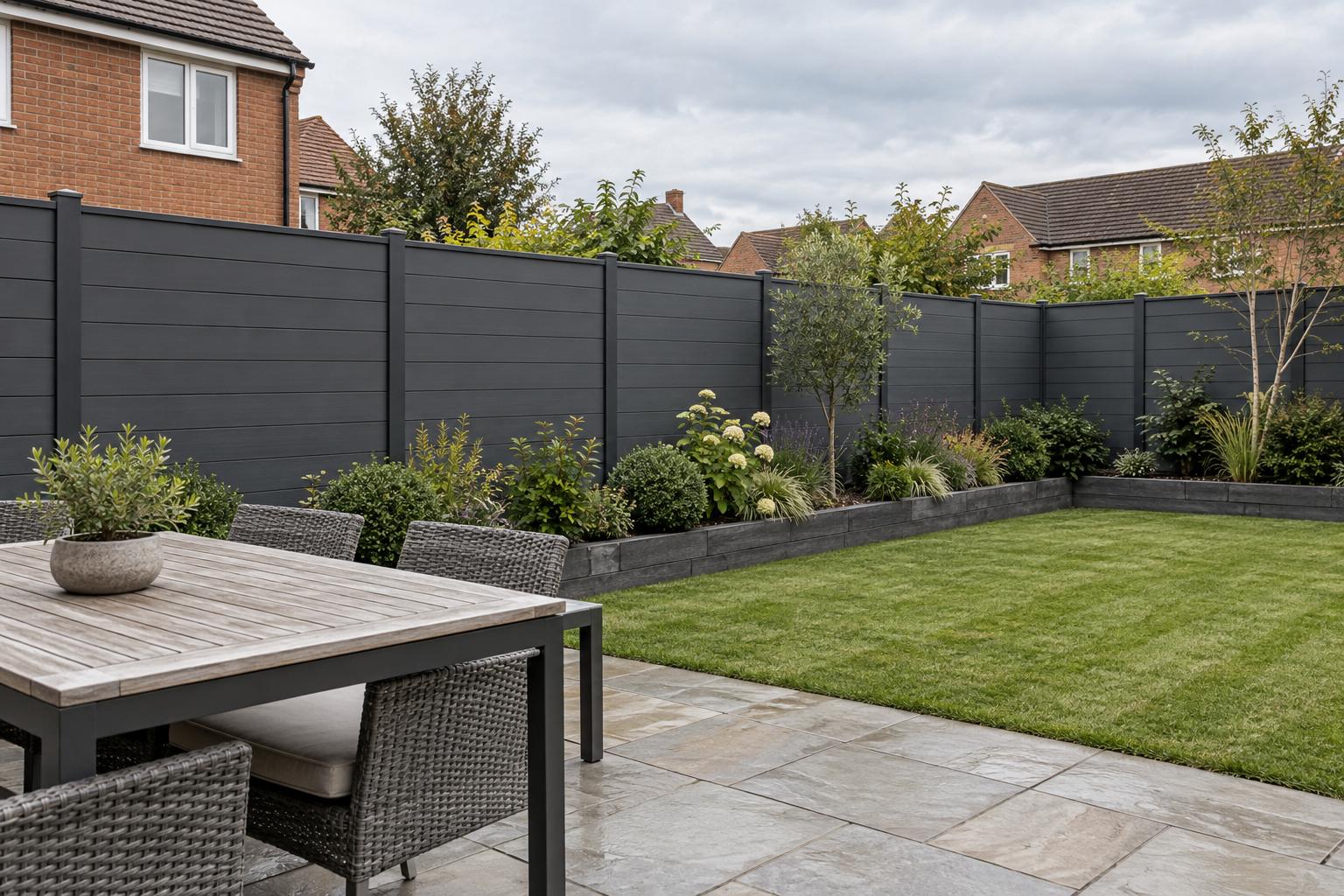
Charcoal composite boards fitted horizontally between posts around a garden

The boards cost more than timber, and the installer has to follow the manufacturer's fitting rules or the guarantee may not hold.

Signs you need composite fencing installation

  • You are tired of staining or replacing a timber fence
  • A damp or shaded boundary rots timber quickly
  • You want a uniform, modern look
  • You want a solid screen for privacy along a boundary
  • You plan to stay in the home for a decade or more
  • Rotting posts and boards keep recurring along one boundary

Composite Fencing Installation: methods and options explained

  • Composite boards in aluminium posts. A lightweight system with slotted posts that hold boards firmly. Common on higher-spec installations.
  • Composite boards in concrete posts. Concrete posts with slots take composite boards on a stout base. Check that the chosen boards are approved for those posts.
  • Composite panels. Pre-assembled panels that fix between posts. Quicker to fit than a board system, but less flexible.
  • Hybrid designs. Timber or aluminium posts with a composite infill, or a mix of fence and screens for a feature boundary.

What to include when asking for a quote

Give the run lengths and the height you want, and mark corners, gates and changes of level. Say whether you have a manufacturer or finish in mind, and ask for samples before ordering.

Tell the installer whether the site is flat, sloping or stepped, and how materials can reach the garden. Boards are long and heavy, and a narrow side passage may mean carrying every board by hand.

A quote should name the system, the post type and spacing, the board colour and finish, and the guarantee. Check that gravel boards, caps, gate fittings and delivery are in the price, and whether the warranty requires an approved installer.

How much does composite fencing installation cost?

Typical UK costs for composite fencing installation
Type of jobTypical cost
Short run up to 6 m£1,200–£1,800
Typical garden, 10–15 m£1,800–£3,000
Long run, slopes or corner turns£3,000–£4,000+

These are indicative UK budgeting figures, not fixed quotes. Premium systems, long runs and sloping ground can push the total above the top of the range.

Composite is priced as a system. Check what the manufacturer's guarantee requires, because a poorly fitted fence may not be covered.

The composite fencing installation process: what to expect

  1. Survey and choose. The run is measured and the system, colour and finish are agreed.
  2. Order. The system is ordered and delivered, which can take a few weeks.
  3. Set the posts. Posts go in at the manufacturer's spacing and are left to set.
  4. Fit the boards. Gravel boards, boards and caps are slotted in, with expansion gaps left.
  5. Finish. Offcuts and packaging are cleared, and the guarantee paperwork is handed over.

Planning permission and building regulations

Planning rules differ across the UK. Check with the local planning authority before changing a boundary, especially beside a road or at a listed property. The linked Planning Portal guidance is for England; local restrictions and removed permitted development rights can affect what is allowed. See the Planning Portal guidance on fences, gates and garden walls.

Check restrictive covenants, conservation area and listed building rules before ordering a system, and read the manufacturer's guarantee terms carefully.

How to choose a contractor for composite fencing installation

  • Are they approved by the manufacturer of the system?
  • Which system, colour and finish are in the quote?
  • What guarantee comes with the boards and the installation?
  • How will they handle slopes, corners and gates?
  • How long is delivery, and when can they start?

Frequently asked questions

Is composite fencing worth the extra cost?

It can reduce the time spent staining timber, but costs more to buy and fit. Compare the installation price, cleaning requirements and product warranty before deciding whether it suits your garden.

How long does composite fencing last?

Lifespan depends on the product, installation and exposure. A warranty is not a promise of service life; read the term, exclusions and maintenance requirements for the system quoted.

Does composite fencing need treatment?

No staining or sealing is needed. An occasional wash with water and a soft brush keeps it clean.

Can composite fencing go on a slope?

Yes, but boards are usually stepped rather than raked, which creates gaps at the bottom of each bay. Ask how the installer will handle your slope.

Find Composite Fencing Installation Specialists by County

Select your county to browse local composite fencing installation contractors and request free quotes.

Aberdeen City
Scotland
5 towns covered
Aberdeenshire
Scotland
10 towns covered
Anglesey
Wales
7 towns covered
Angus
Scotland
6 towns covered
Argyll and Bute
Scotland
6 towns covered
Bedfordshire
East of England
15 towns covered
Berkshire
South East England
15 towns covered
Blaenau Gwent
Wales
6 towns covered
Bridgend
Wales
6 towns covered
Bristol
South West England
12 towns covered
Buckinghamshire
South East England
15 towns covered
Caerphilly
Wales
7 towns covered
Cambridgeshire
East of England
15 towns covered
Cardiff
Wales
7 towns covered
Carmarthenshire
Wales
7 towns covered
Ceredigion
Wales
6 towns covered
Cheshire
North West England
16 towns covered
City of Edinburgh
Scotland
6 towns covered
Clackmannanshire
Scotland
5 towns covered
Conwy
Wales
6 towns covered
Cornwall
South West England
20 towns covered
County Antrim
Northern Ireland
10 towns covered
County Armagh
Northern Ireland
7 towns covered
County Down
Northern Ireland
10 towns covered
County Durham
North East England
15 towns covered
County Fermanagh
Northern Ireland
5 towns covered
County Londonderry
Northern Ireland
7 towns covered
County Tyrone
Northern Ireland
7 towns covered
Cumbria
North West England
15 towns covered
Denbighshire
Wales
6 towns covered
Derbyshire
East Midlands
15 towns covered
Devon
South West England
20 towns covered
Dorset
South West England
15 towns covered
Dumfries and Galloway
Scotland
7 towns covered
Dundee City
Scotland
4 towns covered
East Ayrshire
Scotland
6 towns covered
East Dunbartonshire
Scotland
5 towns covered
East Lothian
Scotland
6 towns covered
East Renfrewshire
Scotland
5 towns covered
East Riding of Yorkshire
Yorkshire and the Humber
14 towns covered
East Sussex
South East England
15 towns covered
Essex
East of England
20 towns covered
Falkirk
Scotland
6 towns covered
Fife
Scotland
10 towns covered
Flintshire
Wales
6 towns covered
Glasgow City
Scotland
7 towns covered
Gloucestershire
South West England
15 towns covered
Greater London
London
30 towns covered
Greater Manchester
North West England
20 towns covered
Gwynedd
Wales
7 towns covered
Hampshire
South East England
20 towns covered
Herefordshire
West Midlands
10 towns covered
Hertfordshire
East of England
16 towns covered
Highland
Scotland
10 towns covered
Inverclyde
Scotland
5 towns covered
Isle of Wight
South East England
10 towns covered
Kent
South East England
20 towns covered
Lancashire
North West England
20 towns covered
Leicestershire
East Midlands
15 towns covered
Lincolnshire
East Midlands
18 towns covered
Merseyside
North West England
14 towns covered
Merthyr Tydfil
Wales
5 towns covered
Midlothian
Scotland
5 towns covered
Monmouthshire
Wales
6 towns covered
Moray
Scotland
6 towns covered
Na h-Eileanan Siar
Scotland
5 towns covered
Neath Port Talbot
Wales
6 towns covered
Newport
Wales
6 towns covered
Norfolk
East of England
16 towns covered
North Ayrshire
Scotland
6 towns covered
North Lanarkshire
Scotland
7 towns covered
North Yorkshire
Yorkshire and the Humber
18 towns covered
Northamptonshire
East Midlands
15 towns covered
Northumberland
North East England
15 towns covered
Nottinghamshire
East Midlands
15 towns covered
Orkney Islands
Scotland
4 towns covered
Oxfordshire
South East England
15 towns covered
Pembrokeshire
Wales
7 towns covered
Perth and Kinross
Scotland
7 towns covered
Powys
Wales
8 towns covered
Renfrewshire
Scotland
6 towns covered
Rhondda Cynon Taf
Wales
7 towns covered
Rutland
East Midlands
10 towns covered
Scottish Borders
Scotland
7 towns covered
Shetland Islands
Scotland
4 towns covered
Shropshire
West Midlands
15 towns covered
Somerset
South West England
18 towns covered
South Ayrshire
Scotland
5 towns covered
South Lanarkshire
Scotland
8 towns covered
South Yorkshire
Yorkshire and the Humber
14 towns covered
Staffordshire
West Midlands
15 towns covered
Stirling
Scotland
5 towns covered
Suffolk
East of England
15 towns covered
Surrey
South East England
20 towns covered
Swansea
Wales
6 towns covered
Torfaen
Wales
5 towns covered
Tyne and Wear
North East England
13 towns covered
Vale of Glamorgan
Wales
6 towns covered
Warwickshire
West Midlands
13 towns covered
West Dunbartonshire
Scotland
4 towns covered
West Lothian
Scotland
6 towns covered
West Midlands
West Midlands
18 towns covered
West Sussex
South East England
15 towns covered
West Yorkshire
Yorkshire and the Humber
18 towns covered
Wiltshire
South West England
15 towns covered
Worcestershire
West Midlands
13 towns covered
Wrexham
Wales
6 towns covered
Advertisement