
🪟

Fence Panel Replacement Specialists Across the UK

Swapping out rotten, split or blown-out lap or featheredge panels between sound fence posts, usually with new gravel boards or a post or two where the timber has failed.

💰 Typical cost: £90–£600⏱ Timeframe: 2–6 hours📋 Free surveys available
Job profileCost 1 of 5, Complexity 2 of 5, Duration 1 of 5, Dustiness 1 of 5, Disturbance 2 of 5Cost: 1 of 5Complexity: 2 of 5Duration: 1 of 5Dustiness: 1 of 5Disturbance: 2 of 5Cost1/5Complexity2/5Duration1/5Dustiness1/5Disturbance2/5
What the job involves, at a glance

What is fence panel replacement?

Fence panel replacement is the removal of damaged ready-made panels from an existing fence and the fitting of new ones between the posts. It can be economical when the existing posts and gravel boards are sound. After high winds, have the supports checked before ordering panels.
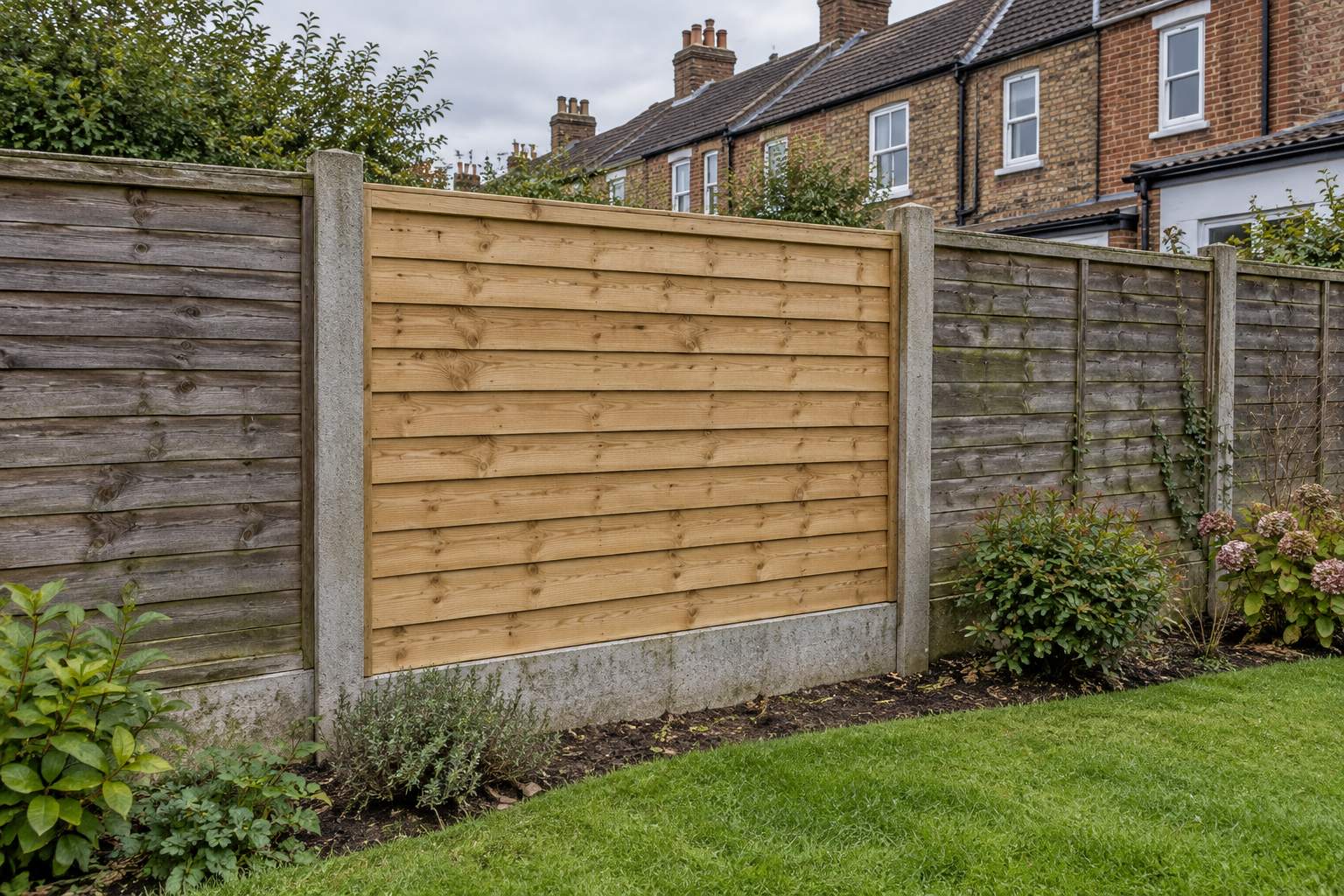
New lap fence panel between existing concrete posts and weathered panels

The posts need to hold firm and the bay widths need checking. The contractor will often need access to both sides.

Signs you need fence panel replacement

  • Panels are split, bowed or missing boards
  • The bottom edge of a panel is soft or crumbling
  • A panel has come away from the posts and hangs loose
  • Gaps are opening between panels and posts
  • Damage from a tree, vehicle or ball has broken a section
  • Mismatched panels along one boundary look untidy

Fence Panel Replacement: methods and options explained

  • Like-for-like swap. A new panel of the same size and style goes between the existing posts. Quickest and cheapest.
  • Panel with gravel board. A concrete or timber gravel board is added at the base so the new panel stays off the soil and lasts longer.
  • Panel plus post repair. Where the post is rotten or loose, it is replaced or supported with a concrete spur first.
  • Full run re-hung. Where most panels have failed, the whole run is replaced, often on new posts, which is close to a fresh fence.

What to include when asking for a quote

Count the damaged panels and say how wide each bay is, because old bays are often not the standard 1.83 m. Mention whether panels are lap, closeboard or horizontal, and whether the existing posts move when pushed.

Say who can give access to both sides of the fence. If the boundary is shared, tell the contractor whether your neighbour knows about the work, since a panel often has to be moved or cut out from their side.

A written quote should list the panel size, thickness and treatment, say whether gravel boards or post repairs are included, and whether disposal of the old panels is covered. A call-out fee that is credited against the work is worth asking about.

How much does fence panel replacement cost?

Typical UK costs for fence panel replacement
Type of jobTypical cost
One or two panels, posts still sound£90–£200
Three to six panels with gravel boards or a post or two£200–£450
Whole run of panels re-hung on new posts£450–£600+

These are indicative UK budgeting figures, not fixed quotes. Call-out charges on very small jobs can be a large share of the total.

Panel prices rise with thickness and treatment. A cheap panel that rots in five years is poor value for a job that costs more in labour than material.

The fence panel replacement process: what to expect

  1. Check. The contractor measures the bays, pushes the posts and decides whether they will carry new panels.
  2. Remove. Damaged panels are unscrewed or cut out and carried away.
  3. Prepare. Gravel boards or battens are fitted where needed, and any rotten post is replaced.
  4. Fit. New panels are set into the bays and fixed securely to the posts.
  5. Tidy. Fixings are checked, the ground is cleared and old panels are taken away.

Planning permission and building regulations

Planning rules differ across the UK. Check with the local planning authority before changing a boundary, especially beside a road or at a listed property. The linked Planning Portal guidance is for England; local restrictions and removed permitted development rights can affect what is allowed. See the Planning Portal guidance on fences, gates and garden walls.

No Building Regulations approval is normally needed for a panel swap. If the fence is on a shared boundary, check your deeds and tell your neighbour before access is needed.

How to choose a contractor for fence panel replacement

  • Will they test the posts before quoting for panels alone?
  • Are the panel size, thickness and treatment stated?
  • Is a gravel board included under each new panel?
  • Will they take away the old panels?
  • What guarantee is given on the panels and the fixings?

Frequently asked questions

How much does it cost to replace a fence panel?

Our guide range is £90–£600 depending on how many panels are needed and the condition of the posts. A single panel on sound posts is at the low end, while a whole run re-hung on new posts is at the top.

Do I need to replace the posts as well?

Not always. If the posts are firm and straight, new panels can go straight in. A rotten or loose post needs replacing first, which adds time and cost.

Will new panels match the old ones?

Rarely at first. New timber is lighter and takes a season or more to weather. A coat of stain on the whole run helps blend them.

What size are standard fence panels?

The most common panel is 1.83 m wide and between 0.9 and 1.83 m high. Non-standard bays need trimming or a made-to-measure panel.

Find Fence Panel Replacement Specialists by County

Select your county to browse local fence panel replacement contractors and request free quotes.

Aberdeen City
Scotland
5 towns covered
Aberdeenshire
Scotland
10 towns covered
Anglesey
Wales
7 towns covered
Angus
Scotland
6 towns covered
Argyll and Bute
Scotland
6 towns covered
Bedfordshire
East of England
15 towns covered
Berkshire
South East England
15 towns covered
Blaenau Gwent
Wales
6 towns covered
Bridgend
Wales
6 towns covered
Bristol
South West England
12 towns covered
Buckinghamshire
South East England
15 towns covered
Caerphilly
Wales
7 towns covered
Cambridgeshire
East of England
15 towns covered
Cardiff
Wales
7 towns covered
Carmarthenshire
Wales
7 towns covered
Ceredigion
Wales
6 towns covered
Cheshire
North West England
16 towns covered
City of Edinburgh
Scotland
6 towns covered
Clackmannanshire
Scotland
5 towns covered
Conwy
Wales
6 towns covered
Cornwall
South West England
20 towns covered
County Antrim
Northern Ireland
10 towns covered
County Armagh
Northern Ireland
7 towns covered
County Down
Northern Ireland
10 towns covered
County Durham
North East England
15 towns covered
County Fermanagh
Northern Ireland
5 towns covered
County Londonderry
Northern Ireland
7 towns covered
County Tyrone
Northern Ireland
7 towns covered
Cumbria
North West England
15 towns covered
Denbighshire
Wales
6 towns covered
Derbyshire
East Midlands
15 towns covered
Devon
South West England
20 towns covered
Dorset
South West England
15 towns covered
Dumfries and Galloway
Scotland
7 towns covered
Dundee City
Scotland
4 towns covered
East Ayrshire
Scotland
6 towns covered
East Dunbartonshire
Scotland
5 towns covered
East Lothian
Scotland
6 towns covered
East Renfrewshire
Scotland
5 towns covered
East Riding of Yorkshire
Yorkshire and the Humber
14 towns covered
East Sussex
South East England
15 towns covered
Essex
East of England
20 towns covered
Falkirk
Scotland
6 towns covered
Fife
Scotland
10 towns covered
Flintshire
Wales
6 towns covered
Glasgow City
Scotland
7 towns covered
Gloucestershire
South West England
15 towns covered
Greater London
London
30 towns covered
Greater Manchester
North West England
20 towns covered
Gwynedd
Wales
7 towns covered
Hampshire
South East England
20 towns covered
Herefordshire
West Midlands
10 towns covered
Hertfordshire
East of England
16 towns covered
Highland
Scotland
10 towns covered
Inverclyde
Scotland
5 towns covered
Isle of Wight
South East England
10 towns covered
Kent
South East England
20 towns covered
Lancashire
North West England
20 towns covered
Leicestershire
East Midlands
15 towns covered
Lincolnshire
East Midlands
18 towns covered
Merseyside
North West England
14 towns covered
Merthyr Tydfil
Wales
5 towns covered
Midlothian
Scotland
5 towns covered
Monmouthshire
Wales
6 towns covered
Moray
Scotland
6 towns covered
Na h-Eileanan Siar
Scotland
5 towns covered
Neath Port Talbot
Wales
6 towns covered
Newport
Wales
6 towns covered
Norfolk
East of England
16 towns covered
North Ayrshire
Scotland
6 towns covered
North Lanarkshire
Scotland
7 towns covered
North Yorkshire
Yorkshire and the Humber
18 towns covered
Northamptonshire
East Midlands
15 towns covered
Northumberland
North East England
15 towns covered
Nottinghamshire
East Midlands
15 towns covered
Orkney Islands
Scotland
4 towns covered
Oxfordshire
South East England
15 towns covered
Pembrokeshire
Wales
7 towns covered
Perth and Kinross
Scotland
7 towns covered
Powys
Wales
8 towns covered
Renfrewshire
Scotland
6 towns covered
Rhondda Cynon Taf
Wales
7 towns covered
Rutland
East Midlands
10 towns covered
Scottish Borders
Scotland
7 towns covered
Shetland Islands
Scotland
4 towns covered
Shropshire
West Midlands
15 towns covered
Somerset
South West England
18 towns covered
South Ayrshire
Scotland
5 towns covered
South Lanarkshire
Scotland
8 towns covered
South Yorkshire
Yorkshire and the Humber
14 towns covered
Staffordshire
West Midlands
15 towns covered
Stirling
Scotland
5 towns covered
Suffolk
East of England
15 towns covered
Surrey
South East England
20 towns covered
Swansea
Wales
6 towns covered
Torfaen
Wales
5 towns covered
Tyne and Wear
North East England
13 towns covered
Vale of Glamorgan
Wales
6 towns covered
Warwickshire
West Midlands
13 towns covered
West Dunbartonshire
Scotland
4 towns covered
West Lothian
Scotland
6 towns covered
West Midlands
West Midlands
18 towns covered
West Sussex
South East England
15 towns covered
West Yorkshire
Yorkshire and the Humber
18 towns covered
Wiltshire
South West England
15 towns covered
Worcestershire
West Midlands
13 towns covered
Wrexham
Wales
6 towns covered
Advertisement